

Overview
Business Logic Validation lets you confirm that a pull request implements the expected behaviour described in a spec, document, or ticket. Kody analyzes the PR diff, brings in the referenced business context, and flags mismatches before you merge.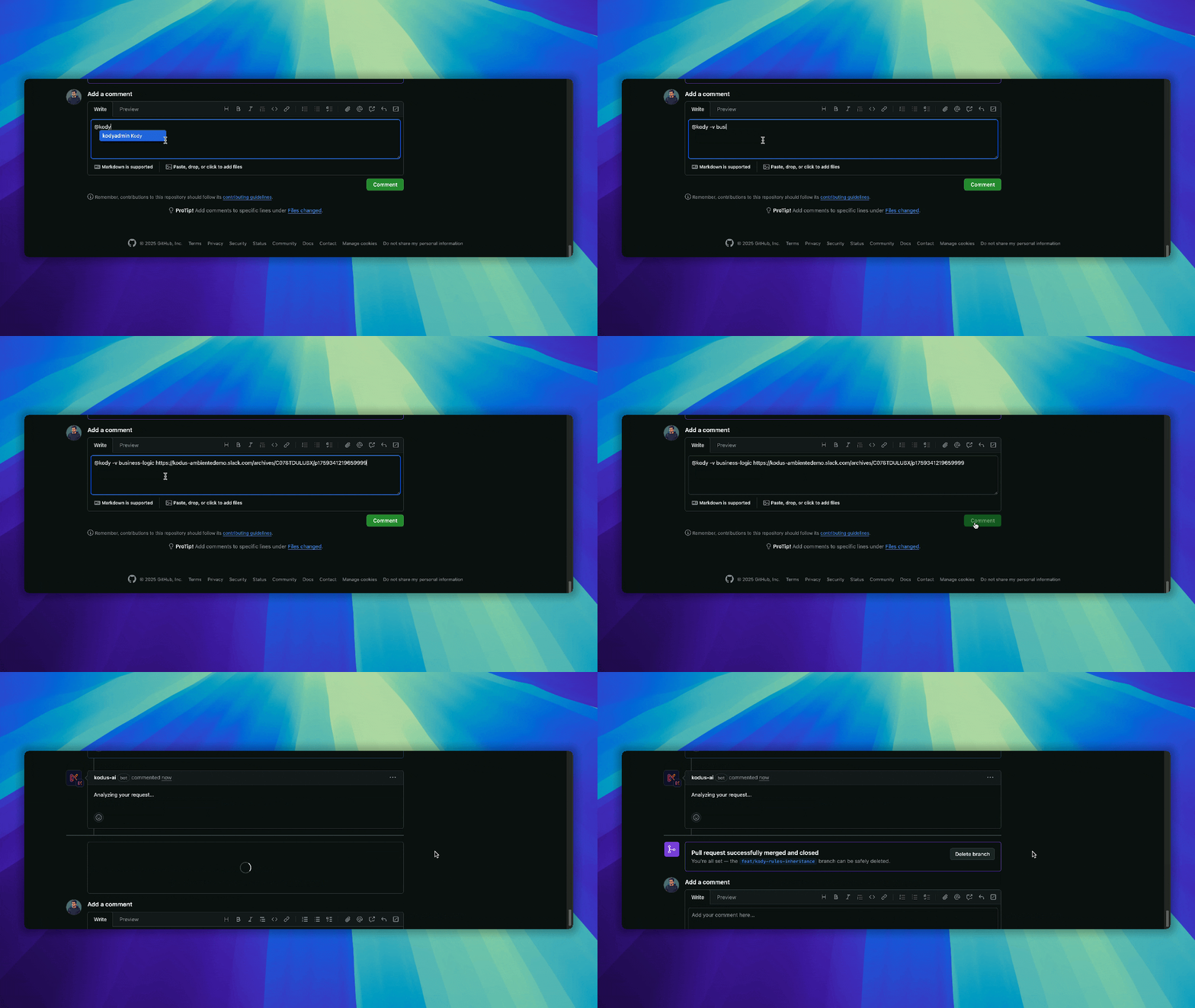
Prerequisites
- If you want Kody to automatically fetch task context from tools like Jira, Linear, Notion, or ClickUp, the corresponding plugin must be connected in your workspace’s Plugins page.
- Any link you share (Jira, Slack, Google Docs, etc.) must be reachable through the plugins installed in your workspace.
- You can always provide the spec inline without any plugin — just paste the requirements directly in the PR comment.
Enabling Business Logic Validation
Business Logic Validation is enabled by default. You can control it in two ways: Viakodus-config.yml:
Running On-Demand
You can also trigger validation manually at any time:- Open the main PR comment box (outside of inline code suggestions).
- Mention Kody and add the validation command:
@kody -v business-logic .... - Provide the spec content inline or paste a link that Kody can fetch via the available plugins.
- Submit the comment and wait for Kody’s response in the same thread.
Examples
- Jira ticket:
@kody -v business-logic https://kodustech.atlassian.net/jira/software/c/projects/KC/boards/2?selectedIssue=KC-1292 - Linear issue:
@kody -v business-logic https://linear.app/your-team/issue/TEAM-123 - Notion page:
@kody -v business-logic https://www.notion.so/your-workspace/Feature-Spec-abc123 - Google Doc:
@kody -v business-logic https://docs.google.com/document/d/1234567890/edit - Slack conversation:
@kody -v business-logic https://kodustech.slack.com/archives/C070E5E97DE/p1727814000000000 - Inline spec snippet:
@kody -v business-logic Rule XYZ — orders above $500 must issue cashback credits.
What Kody Does
- Fetches the PR diff and pull request metadata.
- Retrieves the task context — from the linked task management tool (Jira, Linear, etc.) or from inline text you supplied.
- Classifies task context quality — determines how thorough the analysis can be based on available information.
- Compares implementation against requirements — checks each acceptance criterion against the PR diff.
- Reports findings with severity levels and requirement tracing.
Task Context Quality
Kody automatically classifies the quality of the task context before analysis, which affects the depth of validation:Understanding the Output
Finding Severities
Each finding includes a severity level:- MUST_FIX — A required business rule is not implemented, is incorrect, or contradicts task requirements
- SUGGESTION — A relevant edge case, robustness, or maintainability point is not covered
- INFO — Useful observation that does not block compliance
Grounded Findings
Every finding is traceable to a specific requirement from the task context. Each finding includes:- Requirement — The exact quote from the task that establishes the requirement
- Missing in code — What is absent or wrong in the PR diff
- Suggested action — A concrete implementation action
Scope Mismatch Detection
If the PR diff appears to be working in a different domain than the task itself, Kody detects this as a scope mismatch and reports it as the leading finding, rather than producing misleading gap analysis.Example Output
Tips
- Break large specs into sections and validate them individually to keep feedback focused.
- When sharing private links, double-check that the required plugin (e.g., Jira, Slack, Google Drive) is installed and authorized for your workspace.
- After addressing findings, rerun the command to confirm the PR now aligns with the business rules.
- Provide acceptance criteria in your task for the most thorough analysis — tasks with explicit criteria get criterion-by-criterion validation.